
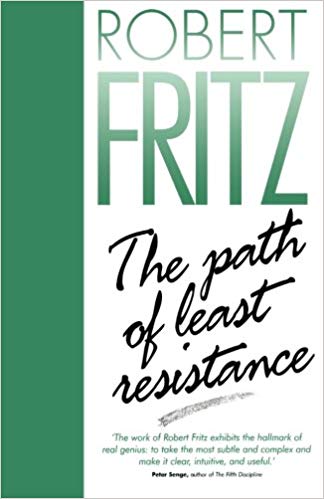
I am on Patrick O’Shaughnessy’s mailing list for book recommendation. He normally provides a list of names each month. However, in an email not long ago, he recommended one book only. And that is how I discovered The Path of Least Resistance.
Robert Fritz, the author, is a creator by trade. In this book, he talks about how to apply creative process to daily life and to build a life you truly want.
What is the path of least resistance?
We do things in certain ways because the underlying structure is already there thus it is the easiest/most convenient–the path of least resistance. However, we rarely question whether the underlying structure makes sense in the first place. One example the author gave in the book early on is that the city planning of Boston is actually formed by utilizing 17th century cow paths. It is amusing to know that the brightest city in America (>50% of its residents with masters degrees or higher) still relies on 17th century cows’ wisdom to plan its transportation system.
The key takeaway is that, the existing path is neither nature nor inevitable, and very often, it is built on historical incidents that not necessarily make sense.
Energy follows the path of least resistance
We all know it is hard to form new good habits. Just see how many people rush into gyms in January and how many of them are still there in February? A lot of books or motivation speakers may tell you that will power will get you there. The truth is that, will power will only take you so far.
The key is how you frame it in your mind.
If you view forming new/good habits as tactics to solve specific problems you have in life, then you are onto an endless journey of problem solving. There will always be new problems. A really good friend of mine once told me the essence of life is to solve the problems and stay away from the worries. However, if you frame life in this way, you have given away the driver seat to your environment and your immediate social circle. Rather than focusing on solving problems, you should really focus on creating a life you want. Problem solving is reactive, but creating is proactive. Set up a strategic view of your future and the tactics will follow.
Build a new structure that supersedes the old structure
The new vision of your life needs to be built on a new underlying structure for it to work. Otherwise, the existing structure is so strong that it will pull you back to where you were originally. Moreover, for this new structure to work, it has to be a simple tension-resolution system. It needs to be simple, so that it can take priority over the current complex system. It needs to have tension so there is something for a creative process to resolve. In this new system, the structural tension is the gap between the vision you want to create and the reality you are in now. As soon as this is done, the newly formed structural tension will direct the energy to craft a creative process to resolve the tension. It may well require things that already exist in your toolkits but it may also call for skills/resources that are not readily available or even unexpected.
I might have read a few clever books previously, but I do find this book fundamentally changed my perspective on how to achieve a desirable life.
 Dreamerella